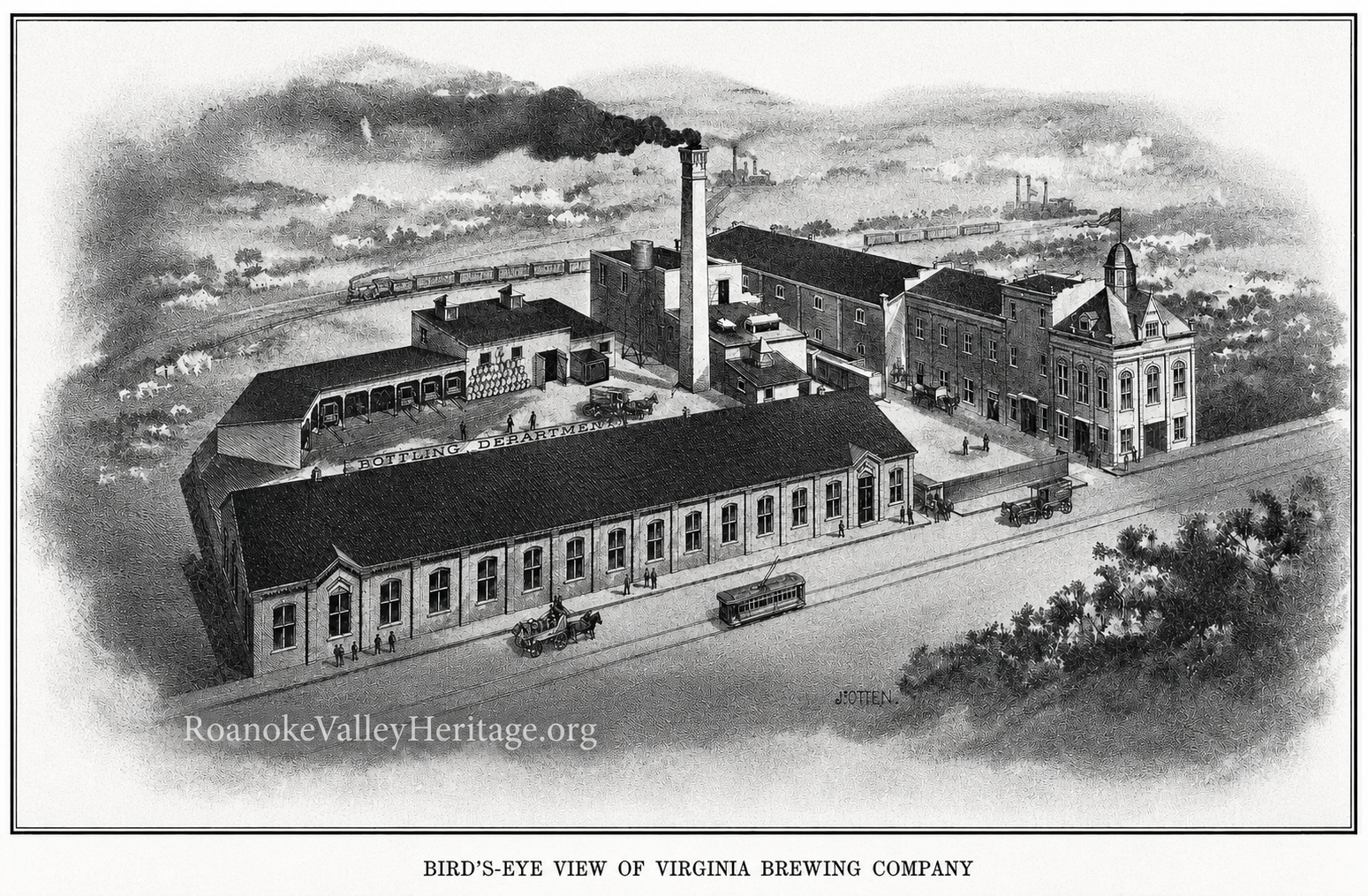
Long before the rise of today’s craft beer movement, Roanoke was home to one of Virginia’s most successful breweries. The Virginia Brewing Company, founded in December 1889 by a group of Roanoke investors, quickly became one of the city’s largest industrial employers and an important part of the “Magic City’s” rapid growth during the late 19th and early 20th centuries.
German-trained brewer Louis A. Scholz was recruited from Baltimore to manage the new brewery, while local businessman Hermann Cruger served as the company’s first president. Following Cruger’s tenure, Scholz became president and guided the brewery through decades of expansion. Under his leadership, Virginia Brewing Company earned a reputation for producing high-quality beer while steadily growing its market throughout the Southeast.
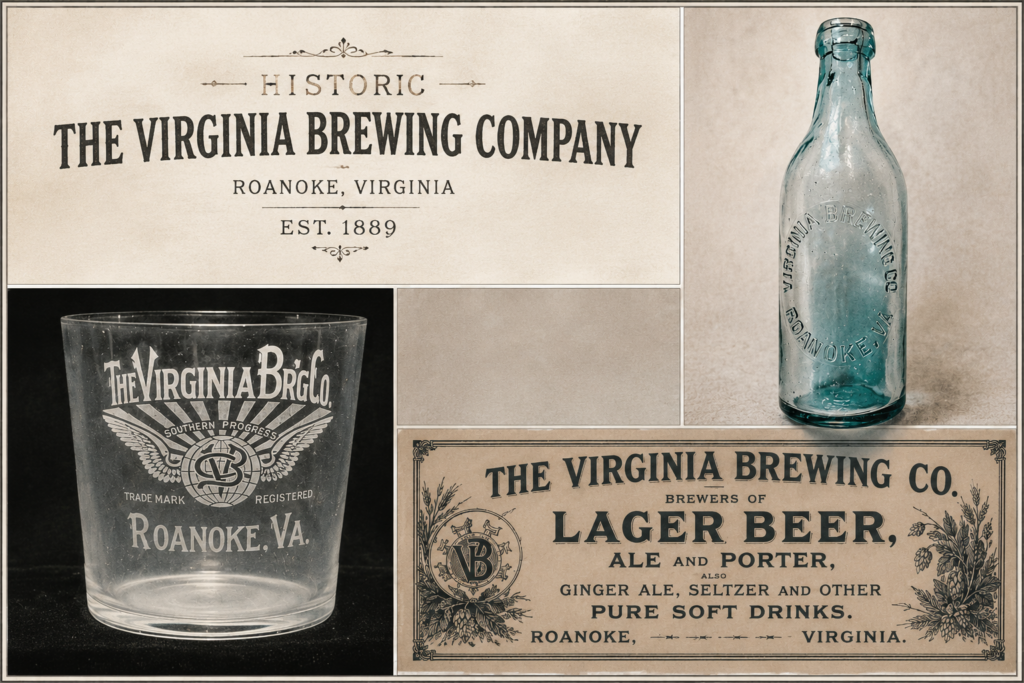
The brewery began with an initial capitalization of $50,000 in 1889. As demand increased, that investment grew to $80,000 by 1892 and reached $250,000 by 1905—an enormous sum for the era that reflected the company’s remarkable success.
Located on a four-acre campus in Roanoke, the brewery featured modern brick buildings and state-of-the-art equipment. At its peak, the facility produced approximately 50,000 barrels of beer annually, while its bottling department had the capacity to fill 400,000 dozen bottles each year. In addition to beer, the company also manufactured soft drinks.
The brewery emphasized cleanliness and quality control, promoting hygienic manufacturing practices that were considered advanced for the time. Those efforts helped establish the Virginia Brewing Company as one of the region’s premier breweries.
Its products were distributed across Virginia, West Virginia, North Carolina, South Carolina, and Tennessee, with additional shipments reaching other parts of the South. Historical accounts suggest the brewery’s first pilsner was so well received that its initial production sold out on its first day of sale. The brewery later earned a gold medal at the 1907 Jamestown Tercentennial Exposition, further cementing its reputation for quality.
Growth brought continual expansion to the brewery complex. After a devastating fire heavily damaged the facility, much of the plant was rebuilt with modern improvements, leaving little of the original structure standing.
The company also expanded beyond brewing. Adjacent to the brewery stood the Consolidated Ice Company, a business in which Virginia Brewing Company held a major interest. The ice plant eventually became one of the largest ice manufacturing and cold-storage operations in Virginia, producing approximately 100 tons of ice daily. Together, the brewery and ice company employed around 150 people, making them significant contributors to Roanoke’s industrial economy.
Louis A. Scholz served as president of both companies, while his brother, Henry Scholz, acted as secretary and treasurer. The brothers also invested in other local ventures, including the Cooper Silica and Glass Company and the Roanoke Fair Association, helping shape Roanoke’s business community during its years of rapid expansion.
Like many American breweries of its era, Virginia Brewing Company’s success came to an abrupt end with the arrival of Prohibition. Virginia enacted statewide prohibition in 1916, forcing the brewery to cease beer production years before national Prohibition took effect. The company closed its doors, and much of its brewing equipment was later sold for scrap during World War I.
Although there were later attempts to revive the brewery after Prohibition ended, the original Virginia Brewing Company never regained the prominence it once enjoyed. Today, its story remains an important chapter in Roanoke’s industrial history—a reminder that long before the modern craft beer era, the Magic City was already home to one of Virginia’s largest and most influential breweries.